A stone facade gives a building its first impression. Colour, texture, and proportion all influence how that building feels, whether it is a private residence, a corporate office, or a hotel.
But choosing facade stone requires more than finding an attractive sample. The material must suit the building’s exposure, architectural details, and installation system. A successful choice brings appearance and performance together.
A stone facade is an exterior building surface finished with natural stone. Depending on the design, stone may cover an entire elevation or form selected features around entrances, columns, balconies, and other architectural elements.
The stone is part of a larger construction assembly. Its performance depends on the backing structure, fixing method, joints, and details that manage water and movement.
Before comparing materials, consider the role stone should play in the architecture.
Should the facade feel quiet and understated, or bold and expressive? Will the stone create a consistent background, or become the main visual feature?
Large panels can emphasise clean geometry. Smaller pieces can introduce rhythm and texture. Strong veining may create a distinctive composition, while a more uniform stone can support a restrained design.
The right choice should make sense across the whole building, including its windows, roofline, entrance, and surrounding landscape.
Stone names describe broad material groups. Individual varieties can differ considerably, so selection should be based on the specific stone rather than its name alone.
| Stone Type | Visual Character | Main Selection Consideration |
|---|---|---|
| Granite | Often granular, with a broad range of colours | Assess the particular variety, finish, and panel requirements |
| Sandstone | Earthy colours and visible natural texture | Check strength, absorption, and suitability for exposure |
| Limestone | Often subtle, with softer visual variation | Review weathering behaviour and local environmental conditions |
| Marble | Distinctive veining and varied colour patterns | Assess exterior suitability and acceptable changes in appearance |
| Slate | Layered texture and a distinctive surface | Check splitting behaviour and compatibility with the fixing design |
A stone used successfully indoors should not automatically be assumed suitable for an exterior facade.
The same material can behave differently under different conditions.
Sun, rainfall, airborne dirt, temperature changes, and surrounding vegetation all affect the facade’s appearance and maintenance needs. Coastal conditions or pollution may introduce further considerations.
Pay attention to the building’s individual elevations. A sheltered entrance and an exposed upper wall may experience very different conditions.
Ask for relevant material information and evidence of use in comparable environments. Appearance alone cannot establish suitability.
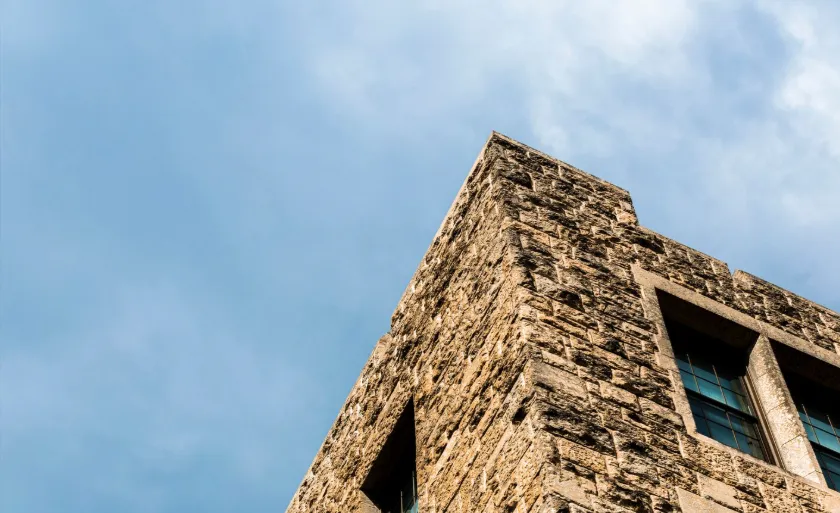
The finish changes how stone reflects light and how its texture is perceived.
A polished surface creates a reflective appearance and can emphasise colour and veining. Its suitability should be assessed for the specific stone and exterior conditions.
A honed finish produces a smooth surface with a more subdued appearance. It can work well where the design calls for limited reflection.
Depending on the stone, textured finishes may include flamed, brushed, bush-hammered, or split-face treatments.
These can add visual depth, but pronounced texture may also influence how dirt collects and how the surface is cleaned.
Not every finish is appropriate for every stone. Confirm what can be achieved consistently before finalising the specification.
Panel dimensions are an architectural decision with technical consequences.
The proposed stone must be assessed alongside its thickness, support arrangement, and fixing locations. Panel weight, stone strength, wind exposure, and the supporting structure all matter.
Avoid selecting a panel size first and treating the fixing system as a later detail. The stone and its connections should be developed together by the project team.
For mechanically fixed facades, the design must address how loads pass from each panel through the fixings into the building.
Natural stone rarely has the uniformity of a manufactured surface. Differences in shade, grain, fossils, and veining can be part of its appeal.
However, a single small sample may not represent the full supply.
Review a range of samples and, where practical, larger panels from the proposed material. Agree on acceptable variation before installation begins.
For strongly veined stone, panel orientation and arrangement deserve particular attention. A planned layout helps the finished facade feel intentional.
A facade is often judged by its details.
Consider how the stone meets:
Joints, flashings, and drainage provisions need to work with the visual design. The complete facade assembly must also address applicable fire-safety requirements.
These details should be resolved before site installation, when changes are easier to coordinate.
Ask how the facade will be inspected, cleaned, and repaired.
Cleaning methods must suit the particular stone and finish. Products that work on one material may damage another, so maintenance instructions should be agreed with the supplier or specialist.
Access also matters. Upper elevations may require different inspection and cleaning arrangements from ground-level walls.
Where individual panel replacement is important, discuss it during system design. Replacement access depends on the fixing arrangement and surrounding construction.
The stone’s purchase price is only one part of the budget.
Other costs may include fabrication, finishes, testing, fixings, supporting systems, transport, access equipment, installation, and maintenance.
A less expensive material can require more complex preparation or support. Conversely, a simpler panel layout may help control fabrication and installation costs.
Compare complete proposals against the same scope rather than comparing stone prices alone.
RockWallX works with architects, consultants, and developers to execute stone facades across residential, commercial, hospitality, and institutional projects.
Its services include architectural facade solutions, high-rise facade execution, stone fixing and support systems, and custom stone detailing.
To discuss your project requirements, contact info@rockwallx.com.
There is no single best stone for every building. The choice depends on the specific material’s properties, exposure, appearance, fixing system, and maintenance requirements.
Certain varieties may be suitable, but exterior use requires careful assessment. The particular stone, panel design, environmental conditions, and expected weathering must be considered.
The terms overlap. “Facade” describes the building’s exterior face, while “stone cladding” describes a stone covering that may be used on exterior or interior surfaces.
They may be possible where the stone and fixing system are appropriately designed. Panel dimensions must be assessed alongside thickness, strength, loads, and structural support.
Review representative samples, agree on acceptable variation, and plan the panel layout before installation. Natural variation should be understood as part of material selection.
The right facade stone should support the architectural idea and suit the conditions it will face.
Look beyond the sample. Evaluate the material, finish, panel layout, fixing system, and maintenance plan together. That approach gives the finished building both visual coherence and a sound basis for long-term performance.